Fully Funded Scholarships for Pakistani Students: What’s Covered and What Isn’t
Find out what fully funded scholarships cover, which costs you may still need to pay, and how Chevening, Commonwealth Shared and DAAD EPOS compare for Pakistani students.
Last checked: 2 November 2026. Scholarship terms change, so always confirm coverage, eligibility and deadlines on the official programme page and in your award letter.
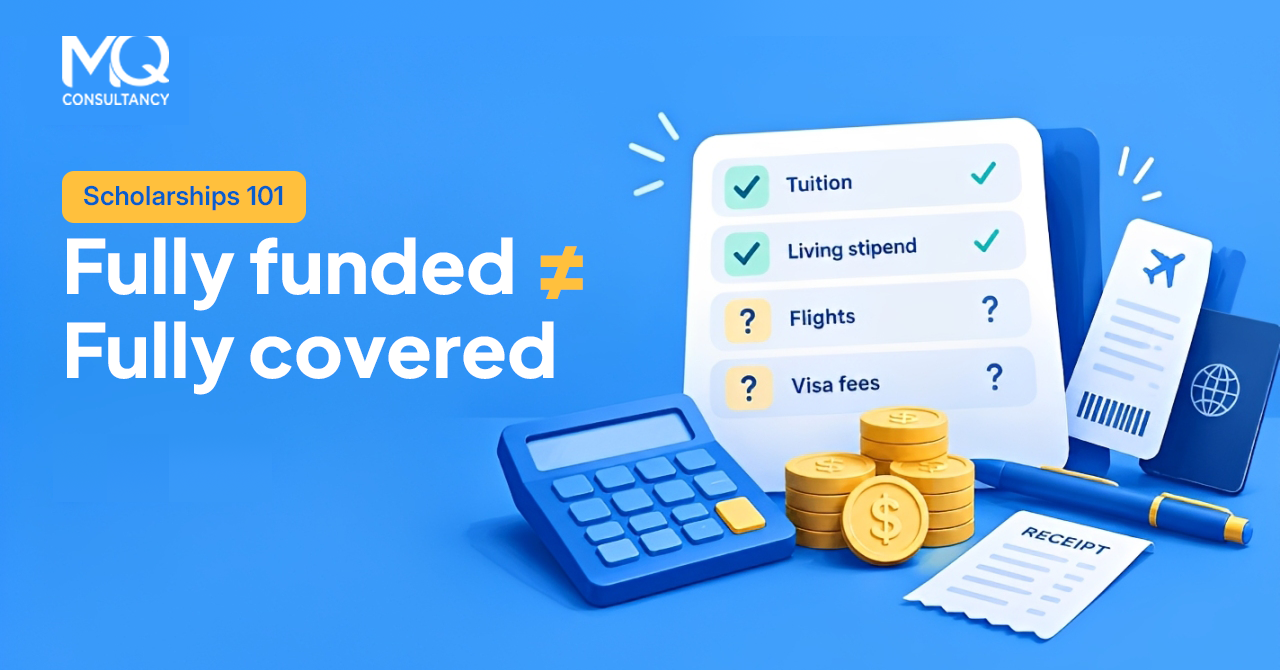
“Fully funded” might be the most exciting phrase in study abroad. It sounds like someone is about to hand you a degree, a flight and a flat. Sometimes it’s close. Often, there are still costs to plan for.
The label alone won’t tell you what’s included. Here’s a clear breakdown of what major scholarships pay for, what they leave to you, and what to check before you spend months on an application.
What “fully funded” usually means
A full funding package generally covers tuition and a stipend, an allowance intended to help with rent, food and daily life. Some awards also cover approved travel, visa costs and other allowances.
But a tuition waiver alone does not pay your living costs. And a stipend does not mean every expense will be reimbursed. Read the official benefits list, payment arrangements and award conditions together.
The useful question is: what will I still need to pay, and when?
What might not be covered
Think of “fully funded” like “all-inclusive” on a hotel booking: great, until you find out the minibar isn’t. Here’s where the gaps can hide:
- English tests and application preparation. You may need to pay English-test fees upfront, alongside document translations or other required preparation. Check whether reimbursement is explicitly offered. The Commonwealth Scholarship Commission itself does not require IELTS, but your university may still require evidence of English proficiency. [1]
- Your family. Funding for you does not automatically extend to dependants. Chevening provides no financial support for them. Commonwealth Shared does not cover dependants’ flights, and any family allowance is conditional and only a contribution towards costs. Funding also does not establish whether family members can obtain visas. [1][2]
- Retakes and extra study time. Chevening’s August 2026 terms exclude fees for resitting exams or resubmitting written work. For any award, check its end date before assuming an extra semester will be funded. [2]
- Costs before the money arrives. A covered expense may still require an upfront payment. Chevening, for example, requires eligible scholars to pay for their TB test first and receive a contribution later. Check payment timing before booking travel or accommodation. [3]
- Tuition gaps and deposits. Some awards have limits. Chevening applies an MBA tuition cap, while its course guidance says it does not pay university tuition deposits. Ask the university whether a deposit can be deferred or waived. [4]
There can also be conditions attached to the funding. Chevening requires scholars to return to their country of award for at least two years after completing the scholarship. Commonwealth Shared requires an undertaking to return home as soon as possible after the award. Check that these conditions fit your plans before applying. [1][5]
Comparing three major scholarship routes
These examples focus on postgraduate study. They are not a complete list of scholarships available to Pakistani students.
Chevening: UK
Pays for: a full award normally includes tuition, a living stipend, approved economy travel for the scholar, a visa application, arrival and departure allowances, and a contribution towards a required TB test. Chevening’s visa guidance also explains how scholars avoid paying the Immigration Health Surcharge. [2][6]
Eligibility to check: you need at least 2,800 hours of work experience gained after completing your undergraduate degree, acquired over a minimum of two years. Work completed during your degree does not meet that post-graduation condition. Eligible courses are generally full-time, UK-based taught master’s programmes lasting nine to 12 months. [4][7]
Funding gaps to check: the MBA tuition contribution is capped at £22,000. Part awards can also exist, so confirm whether your offer covers tuition, living costs or both. [2][4]
Timing: applications for the 2027/28 cycle are closed. Check the Pakistan page and official timeline for the next opening rather than assuming the same dates repeat. [8]
Commonwealth Shared Scholarships: UK
Pays for: approved tuition in full, a living stipend, approved return airfare and specified additional grants, where applicable. The CSC’s visa guidance explains the visa-fee exemption and health-surcharge arrangements. [1][9]
Eligibility to check: Pakistan is eligible. You must meet academic and residency requirements, show that you could not afford UK study without the scholarship, and choose an approved master’s course at a participating university. Previous study or work in a high-income country can affect eligibility. [1]
Applications to check: apply for both the scholarship and university admission. Use the 2027/28 eligible-course list when published, rather than assuming last year’s courses remain eligible. [1]
Timing: applications open 10 November 2026 and close 8 December 2026 at 16:00 GMT, which is 9:00 PM Pakistan time. Check university deadlines separately. [1]
The separate Commonwealth Master’s scholarship route has a different application process. Do not assume its nominating-body requirements apply to Commonwealth Shared.
DAAD EPOS: Germany
Pays for: the current EPOS listing specifies €992 per month for master’s-level graduates, payments towards health, accident and personal liability insurance, and a travel allowance subject to its conditions. Rent and family supplements may be available in certain circumstances. [10]
Eligibility to check: EPOS supports listed development-related postgraduate courses. Applicants normally need an appropriate degree, strong academic results and at least two years of related professional experience after their bachelor’s degree. [10]
Costs to check: do not assume a DAAD award automatically pays any tuition fee a university charges. DAAD’s general guidance says it does not normally pay tuition; check the specific EPOS course’s fee and waiver arrangements. Also check semester contributions and other charges separately. [11]
Timing: deadlines vary by course. Apply through the chosen programme’s stated process; there is no single EPOS deadline for every course. [10]
DAAD is a funding organisation with multiple programmes, not one scholarship with identical rules.
Check eligibility carefully, prepare strong applications and apply to several suitable opportunities. Applying before the deadline gives you time to handle missing documents or technical problems; it does not guarantee selection.
Fully funded, partial and merit-based: what’s the difference?
- Fully funded: a package intended to cover tuition and living costs, often with additional benefits. Check limits and exclusions.
- Partial: covers only part of the cost, such as a tuition discount or a contribution towards living expenses.
- Merit-based: describes why an award is given, such as academic achievement. It does not tell you how much funding it provides.
An award can be both merit-based and fully funded, or merit-based and partial.
A simple way to calculate your funding gap
Use this calculation:
Total expected costs − confirmed scholarship support = the amount you must cover.
Here is an illustrative example, not a quotation for a particular country or scholarship:
| Cost or funding | Example amount |
|---|---|
| Tuition | PKR 2,000,000 |
| Living costs | PKR 1,200,000 |
| Travel, tests, documents and other costs | PKR 300,000 |
| Total expected costs | PKR 3,500,000 |
| Confirmed tuition and living support | PKR 3,200,000 |
| Amount you must cover | PKR 300,000 |
Then ask a second question: how much cash do I need before the funding arrives?
For example, if PKR 100,000 of your confirmed support is reimbursed only after arrival, you would temporarily need PKR 400,000 available: the PKR 300,000 gap plus the PKR 100,000 awaiting reimbursement. The reimbursement changes your cash needs, not your final funding gap.
Use actual university fees, realistic living costs and your confirmed award terms. Do not count an application or conditional possibility as secured funding.
Questions to ask before you apply
- Coverage: does it pay tuition, living costs, flights, visa costs and insurance? Are there caps?
- Payment timing: is support paid upfront, monthly, directly to the university or reimbursed later?
- Eligibility: do I meet the academic, work-experience, citizenship, residency and financial-need rules?
- Deadlines: are there separate scholarship, university or nominating-body deadlines?
- Conditions: must I return home? What happens if I withdraw, fail or need more time?
- Family: is any dependant support available, and what would I need to cover myself?
- Other funding: can I combine awards, and what must I disclose or get approved?
Find funded options that fit your profile
Reading every scholarship page can feel like a part-time job. M&Q Pathfinder’s Scholarship Finder helps you explore potential awards using details such as your education, grades, field, language profile and chosen country. [12]
Use the results as a starting point for your research. Estimated matches are not confirmed eligibility or scholarship offers. Check each award’s official page before applying.
Find scholarships for your profile
FAQ
Is “fully funded” really free?
It can cover the main costs of studying, but that does not mean you will need no money of your own. Check tests, documents, deposits, family expenses and costs due before payments arrive.
Do I need an English-test score?
Requirements depend on the scholarship and university. The CSC does not itself require IELTS, but universities can require evidence of English proficiency. A scholarship’s test policy does not override university admission requirements. [1]
Can I apply for more than one scholarship?
You can pursue several suitable opportunities, subject to each programme’s application rules. Accepting overlapping funding is a separate issue: Commonwealth Shared prohibits concurrent awards covering the same costs, while Chevening’s August 2026 terms prohibit other UK government funding during the scholarship and require approval for specified additional support. Disclose other funding and check before accepting it. [1][2]
Does meeting the eligibility rules guarantee selection?
No. Eligibility allows you to be considered. Your application still has to pass the programme’s selection process.
Plan for the whole cost
“Fully funded” is an exciting possibility. Read the benefits, check the conditions and work out what remains for you to pay. Then focus on opportunities that fit your profile and your plans.
Explore M&Q Pathfinder’s Scholarship Finder
Sources
- Commonwealth Scholarship Commission: Commonwealth Shared Scholarships, eligibility, benefits and 2027/28 dates
- Chevening: Scholarship terms and conditions, August 2026, linked from the current policies page
- Chevening: TB testing and reimbursement
- Chevening: Choosing a UK university course, tuition caps and deposits
- Chevening: Returning home after the scholarship
- Chevening: Scholarship coverage and visa guidance
- Chevening: Work-experience requirements
- Chevening: Pakistan scholarship page and application timeline
- Commonwealth Scholarship Commission: Pre-award FAQs for Shared Scholars
- DAAD: Development-Related Postgraduate Courses, EPOS
- DAAD: General scholarship and grant FAQs
- M&Q Pathfinder: Scholarship Finder